The recent transition of NetXUSA to Vault has left many service providers, MSPs, VARs, and enterprise customers searching for a more stable, transparent, and customer-focused fulfillment partner. We’ve heard from countless teams who are frustrated by the growing pains of that acquisition — from order delays and lack of communication to reduced flexibility in provisioning.
If you’re feeling the impact, you’re not alone — and you have options.
At VoIP Supply, we’ve spent the last two decades building the most complete fulfillment and provisioning solution in the industry. Our Custom Fulfillment Portal was designed specifically for providers like you — giving you full control, visibility, and confidence at every step of your supply chain.
Our provisioning services are fully tailored to your workflows. Whether you need devices pre-configured, labeled, and shipped directly to your customers — or integrated with your own systems — we make it seamless. We even have API integration available!
End-to-End Fulfillment
From warehousing to white-label shipping, we handle it all. Our team acts as an extension of your operations so you can focus on scaling your business — not managing logistics.
Real-Time Portal Access
Our Custom Fulfillment Portal gives you live access to inventory, instant MAC and Serial information, and provisioning updates. It’s built to give you clarity, speed, and control — the way fulfillment should be.
Dedicated Support
With VoIP Supply, you’re never left waiting on a ticket. Our dedicated account managers and fulfillment specialists are here to help — because relationships still matter.
We’re proud to be the trusted fulfillment partner for hundreds of MSPs, VARs, and enterprise customers across North America. From small resellers to national service providers, our solutions scale with you — delivering consistency, accuracy, and peace of mind.
If you’ve been impacted by recent industry changes, now’s the perfect time to explore a partner who’s been doing this right for over 20 years.
Knowing about UC Solutions and how to sell them can lead to added success for any VoIP reseller. This webinar will show you how to capitalize on UC Solutions in Education, Hospitality, Finance, and Healthcare sectors!
While there are many choices when it comes to Unified Communications, this webinar will focus on two manufacturers who are leading the charge! So, tune in as we team up with Yeastar and Fanvil to deliver an insightful and enjoyable webinar that shows you how to use their combined strength to make selling UC Solutions easy!
Are you currently a reseller of Yeastar and Fanvil? Let us know in the comments below!
Did you know the first 9-1-1 call dates back to 1968 in Alabama? AT&T introduced 9-1-1 as an easy-to-dial and remember number for emergency services. What I don’t think they were counting on was that many people in 2025 do not dial the numbers. 20% of all 9-1-1 calls in 2024 were made in a way other than dialing. Some of these methods include E9-1-1(Enhanced 9-1-1) through VoIP technology.
According to a study from Susan Athey and Scott Stern of Stanford University, “We find that, as a result of E911 adoption, patient health measured at the time of ambulance arrival improves, suggesting that E911 enhances the timeliness of emergency response.”
Voice over IP (VoIP) technology is reshaping how institutions – from schools and hospitals to office buildings and city infrastructures – manage safety alerts, paging, and emergency notifications. Many of these agencies, businesses, schools, etc. are making installing VoIP security devices and emergency alerting a top priority. These devices enhance response time, provide easily-accessible one-press button alerting, more accurate location information, enhanced security, and more! Let’s take a look at what type of devices are available, how they work, and why you need them!
Let’s start with why you want VoIP for Emergency communication. VoIP emergency solutions allow organizations to communicate instantly across large spaces with clear audio and visual alerts. Unlike analog systems, VoIP devices are IP-based, meaning they can be remotely configured, monitored, and triggered across networks, even across buildings and campuses. This flexibility and scalability make them ideal for enhancing public safety.
VoIP Supply carries some of the top brands in the IP paging, emergency alerting, and notification category. Let’s take a look at some of these brands and popular devices that aid in emergency response and notifications.
Algo Solutions: A manufacturer of IP endpoints for IP paging, emergency alerting, and secure door or gate entry for UC, collaboration, and mass notification environments.
Education Bundle: This bundle includes the 8305 paging adapter for system management, 8188 IP ceiling speaker for classrooms, 1203 emergency call switch, 8420 IP dual-sided display speaker for hallways or common areas, and the 8186 IP horn speaker for outdoors or large areas.
Algo 1202 Call Button: A high visibility SIP-compliant call box for one-touch customer assistance and emergency notifications. It can be programmed through the web interface to send a notification via voice paging, telephone voice message, text messaging, email, or audible/visual alerting.
Advanced Network Devices: Advanced Network Devices (AND) provides multiple solutions such as paging, intercom, mass notifications, security, audio reinforcement, and more.
IP Speaker with HD Display: Features an 8″ high-efficiency speaker with an audio coverage of 600 ft2. It contains an RGB flashing LED bar to customize additional visual and audio messaging in any color.
Indoor IP Strobe: A PoE strobe with a blue lens that provides an additional mode of visual for emergency alerts and notifications.
Bogen Communications:A trusted leader in telephone paging systems, commercial audio, and advanced communications solutions for education and commercial markets.
Nyquist Digital Call Switch: Enables users to initiate normal, urgent, or emergency calls from classrooms or staff locations via an integrated Nyquist intercom speaker.
CyberData: CyberData provides cutting-edge IP solutions for paging, emergency notifications, and more!
011477 SIP Outdoor Intercom with RFID: Ideal for secure access control settings that require RFID access control and two-way communication. With encrypted RFID, the CyberData 011477 can increase the security of any VoIP installation.
011491 SIP Outdoor Call Button: One-touch programmable calling to an IP phone or for making page announcements. This IP66-rated device is designed for wall mounting in outdoor areas, such as building exteriors, external doors, parking lots, or harsh environments.
Fanvil: SIP intercoms and doorphones are designed for professionals to meet special industry demands and standards. These devices are equipped with a unique feature set including hands-free talking, extra volume levels, function monitoring, and more!
i67 Face Recognition Door Phone: Supports audio and video communication with IP phones, indoor stations, or mobile apps, accelerating response times for visitors, delivery personnel, and service staff, ensuring a positive user experience.
i506W SIP Indoor Station: It provides reliable security and convenient visitor call services for a wide range of users, creating a safe and comfortable living environment.
Valcom: Made in the USA in a state-of-the-art facility, Valcom IP Paging is ideal for warehouses and distribution centers, offices, retail establishments, military installations, schools, car dealerships, manufacturing settings, and hospitals or medical offices.
VIP-429A-D Flush-Mount IP Wall Speaker: A faceplate unit with an integrated digital clock. This model also offers two-way communication, or TalkBack mode.
Viking Electronics: Viking Electronics is a leading manufacturer of security and communication products, specializing in solutions for emergency communication, access control, and mass notification.
IP Emergency Phone Panic Button: Dials up to 5 emergency numbers and can be programmed to automatically deliver a digital voice announcement and/or an optional DTMF touch tone code to identify the location of the emergency call.
VoIP emergency communication is more than just a technical upgrade – it’s a paradigm shift in how institutions protect lives and respond to crises. By integrating smart, scalable, and responsive devices from leading brands, organizations can ensure timely and effective communication when it matters most.
Whether you’re upgrading your facility’s safety infrastructure or building a new system from scratch, solutions from brands like Viking, Bogen, CyberData, Algo, Fanvil, Valcom, and Advanced Network Devices deliver unmatched reliability and innovation in public safety communication. If you have questions or comments, you can leave them below, chat with one of our VoIP experts at www.voipsupply.com, or call us at 1-800-398-8647.
Your May VoIP News Update is here! In this month’s episode, we cover a brand new addition to the Algo Solutions catalog, the Algo 8401 Single-Sided IP Clock. This clock not only offers high visibility, but it’s also designed to integrate with other Algo deployments. Tune in to the episode above to get more information on this impressive device from Algo!
Also in our May VoIP News Update, we break down the new Fanvil H603W Hotel phone. With its 6 programmable soft keys, built-in Wi-Fi 6, and antibacterial materials, it can be considered a high-end Wi-fi phone that prioritizes guest health while making communication easy and efficient. Watch the video for even more features of the new H603W!
Are you interested in the Algo 8401? Are you currently using the Fanvil H603W? Let us know in the comments below!
If you haven’t seen the Fanvil V62W Wi-Fi IP Phone, you may want to check out this video! The phone itself offers a ton of features while remaining at the price point of an entry-level phone. Some of these awesome features include a 2.8-inch color screen, 6 SIP lines, built-in Bluetooth 5.4, 6-party conference calling, and more!
In this video, we’ll get inside the box to show you exactly what this device comes with, set it up, and review all of the features. Additionally, we will walk you through how to SIP register this phone with Sangoma PBXact.
Not only is this phone great for small to medium-sized offices, but it is also very simple to SIP register, making this phone a clear go-to for entry-level communications.
Are you currently using the Fanvil V62W? If so, we want to know what you think, so leave us a comment below!
You want to optimize your meeting space or conference room to ensure every remote or in-person participant has seamless communication capabilities, can easily schedule times without conflict, and can be seen and heard perfectly. That’s awesome! But…how do you know which devices you need, what is compatible with what, where do you put things in the room, and how do you know the system you choose will work with everybody’s devices? These are all terrific questions that can be answered easily without hiring an outside company that might charge you an arm and a leg.
Today’s intelligent room design platforms let you virtually map out your space, select and position hardware, and instantly visualize how everything will work together. Brands like Yealink, HP/Poly, and Jabra now offer design configurators and system-building tools that recommend compatible microphones, cameras, speakerphones, displays, and mounts based on room size and use case. Whether you’re outfitting a small huddle room, a mid-size classroom, or a large boardroom, these tools allow you to tailor audio and video performance with precision.
Let’s take a more in-depth look at some of these tools.
This tool makes it easy to design and implement your ideal meeting space. When you get started, you choose which conferencing provider you prefer. Next, you choose the number of seats and the size/type of room. You then choose your preferred product form (Zoom Room Application or PC Mode), select a Yealink Core Kit, preferred peripherals, accessories, mounting hardware/cables, and preferred service plan. You are then presented with a 3D diagram (device placement included), wiring diagram, and seating diagram. Yealink provides you with each part number and description of the recommended devices.
Yealink has a multitude of video conferencing devices that are compatible with multiple platforms. Some popular options include:
Yealink MS Teams Room System for Small-to-Medium Rooms MVCS40-C4-000 – 1103833: Designed for small to medium conference rooms, providing a complete solution for seamless collaboration. The standard setup includes the high-performance MCore Pro mini-PC, the MTouch E2 touch panel, and Yealink’s innovative SmartVision 40 audio and video integration device.
Yealink 1203684 Android Video Collaboration Kit A10-020: An all-in-one video collaboration bar for workspace and huddle rooms. The A10 brings an excellent audio experience in huddle rooms, even in full-duplex mode, and ensures everyone can be heard and supports cloud video platforms like Microsoft Teams and Zoom, so no room PC is required.
An easy-to-use tool that provides flexibility and options to meet your needs. First, you select the size of your room. Next, you can choose your preferred platform (Teams, Zoom, etc). When you select your platform, the virtual diagram will update with the placement of the devices that are compatible. When you click “view solution,” you are provided with the recommended devices with descriptions and data sheets, a camera coverage diagram, and a cabling diagram.
HP/Poly has many video conferencing devices that are compatible with multiple platforms. Some popular options include:
Poly Studio X52 All-In-One Video Bar 8D8K2AA#ABA: Designed to enhance the experience in hybrid meeting settings. An all-in-one video bar to streamline and elevate meetings by providing cutting-edge audio and video features.
Poly Studio R30 Plus USB Video Bar and BT Remote with HP USB-C Dock G5 9U3U1AA: A simple, powerful solution for small meeting rooms, featuring a video bar, easy-connect dock, and remote control. Connect any compatible laptop with a single USB-C cable for top-quality video, wide 120° camera framing, and clear audio with smart noise reduction.
Use Jabra’s easy-to-navigate configurator to build your ideal meeting room from scratch or explore predefined templates for inspiration. If you choose to configure your room from scratch, you will choose your preferred platform (Teams, Zoom, etc), choose your room size, choose your table shape/size, preferred connection mode, operating system, device placement, video device options, and accessories. When you’re finished, you’ll receive a complete configuration package, including detailed wiring diagrams.
Jabra has a multitude of video conferencing devices that are compatible with multiple platforms. Some popular options include:
Jabra Panacast 50 Room System for Zoom Rooms 8601-432: A comprehensive solution for small to medium-sized rooms. In partnership with Lenovo, Jabra delivers innovative video collaboration experiences designed for effective hybrid work. This trusted combination simplifies video conferencing, enhancing productivity.
Jabra Panacast 50 Video Bar System MS & TC, US Charger-A 8501-232: Featuring world-leading professional audio and a unique 180° field of view – with a state-of-the-art Android processor, for future-ready, no-PC-needed instant collaboration. With an intuitive installation and setup that makes it easy to deploy and manage.
Once you design your room, let one of the VoIP experts help you get all the devices you need. The solutions and tools recommended above can not only save you time and money but will also help relieve the headache of making sure placement, compatibility, cost, etc., are taken care of. These can also help future-proof your investment by ensuring the technology is scalable and interoperable with platforms like Microsoft Teams, Zoom, or Google Meet. If you have any questions or comments, leave them below, chat with one of our VoIP experts at www.voipsupply.com, or call us at 1-800-398-8647.
In the fast-paced world of Telecommunications, things can happen, and sometimes those things require you to return certain products. Whether they arrive damaged, fail to power on, or just won’t operate right, a return or replacement is bound to happen.
That’s why at VoIP Supply, we’ve made it easy for you to create and submit an RMA so that you can keep your business rolling smoothly. Check out our latest walkthrough video with detailed instructions on how to create and submit an RMA for products purchased through VoIP Supply.
In an office setting, there will most likely be a professional business phone on your desk where you can make and receive calls, listen to voicemails, etc. However, if you’re anything like me, I’ve noticed there seems to be more and more buttons, options, and things that light up with no clue what to do with them or how they can help you with your work. Phones, in general, no longer provide you with the ability to make and receive calls as a main form of communication. There are so many more features now that integrate with other platforms, offer more functionality and features, and allow you to boost communication and efficiency in your work and business. Let’s take a look at some of the features of modern VoIP phones and how to maximize them to create better and more efficient communication!
A feature many companies love to utilize is ring groups or ring strategies. VoIP phones provide you with the opportunity to set up specific ring groups per department or any group you choose. For example, if somebody dials the sales department, each sales person’s phone can ring at the same time until answered, or it can “round robin” ring where it would ring one phone and if it was not answered in a certain number of rings (which you can set) then it would ring the next and so on. Utilizing simultaneous rings or “round robin” rings can be very helpful in ensuring no call goes unanswered.
One feature that I particularly like and find super useful is voicemail to email. When somebody leaves you a voicemail message, instead of logging into a mailbox on your phone or fumbling around with multiple buttons on your phone, the voicemail will be automatically transcribed and sent directly to your email. This allows you to receive your messages promptly, give them a quick read, and ensure no more missed voicemails!
How many times have you been on a call, whether using a headset or just speakerphone in your office, when somebody inevitably “pops” in or is incessantly messaging you, completely unaware you are busy? I know it happens to me a lot, and I have certainly done it to others, oops. Most modern VoIP phones allow users to set their availability (available, busy, in a meeting, etc.). Team members can see each other’s status at a glance, minimizing unnecessary call attempts and interruptions.
Remote or hybrid work? No problem. Configure call forwarding or use a mobile app to ensure employees can take calls on the go without missing a beat. You can also enable call recording for training, quality control, and seamless consistency across your workforce, whether full in-office, hybrid, or fully remote.
One of the last and perhaps most game-changing features of modern VoIP phones is the ability to leverage conference calling and video integration for consistent and efficient communication. Many VoIP phones support built-in conferencing or integrate with video platforms like Zoom or Microsoft Teams. Use these tools to reduce meeting friction and foster better cross-team collaboration.
Below you will find some examples of modern VoIP phones that include everything mentioned above, as well as some specifically tailored for Zoom or Microsoft Teams.
Fanvil X4U-V2 12-Line Mid-level IP Phone: Offers dual color displays, HD audio, dual Gigabit ports, and support for 30 DSS keys, making it ideal for efficient call handling.
Grandstream GXP2170 Enterprise IP Phone: Features a 4.3-inch color display, 12 programmable keys, HD audio, Gigabit support, and advanced security protocols for seamless business communication.
Poly VVX 450 12-Line PoE IP Phone 8B1L7AA#AC3: Offers a color display, HD audio, 12-line support, and advanced call management features, making it ideal for high-demand environments.
VoIP phone systems come packed with powerful features designed to enhance communication. By aligning these tools with your teams’ needs and ensuring everyone knows how to use them, you can boost efficiency, reduce downtime, and create a more connected workplace. If you have any comments or questions, leave them below, chat with one of our VoIP Experts at www.voipsuply.com, or call us at 1-800-398-8647.
We’re back with more VoIP News for April 2025! In this month’s episode, we’ll cover the new VIK-01 Intercom Kit from Fanvil! This kit is not only plug-and-play but also perfect for businesses looking for a cost-effective way to enhance their security! This kit comes with the Fanvil i60 Entry Level Door Phone, and the i504W Indoor Station. These two fantastic and easy-to-use devices will allow you to unlock and lock your door from anywhere with seamless app integration, and more! Tune in to learn more about the VIK-01 Kit!
Additionally, we’ll cover a webcam from our partners at JPL Telecom! The Vision Access 1080P HD USB-A and USB-C Webcam No Mic TAA is the perfect webcam for those who are looking to stay private! This webcam has no microphone and is also TAA-compliant. Get all of the features and functionality of this webcam in this month’s VoIP News Update!
Are you currently using Fanvil for your door security? We want to know, so leave a comment below!
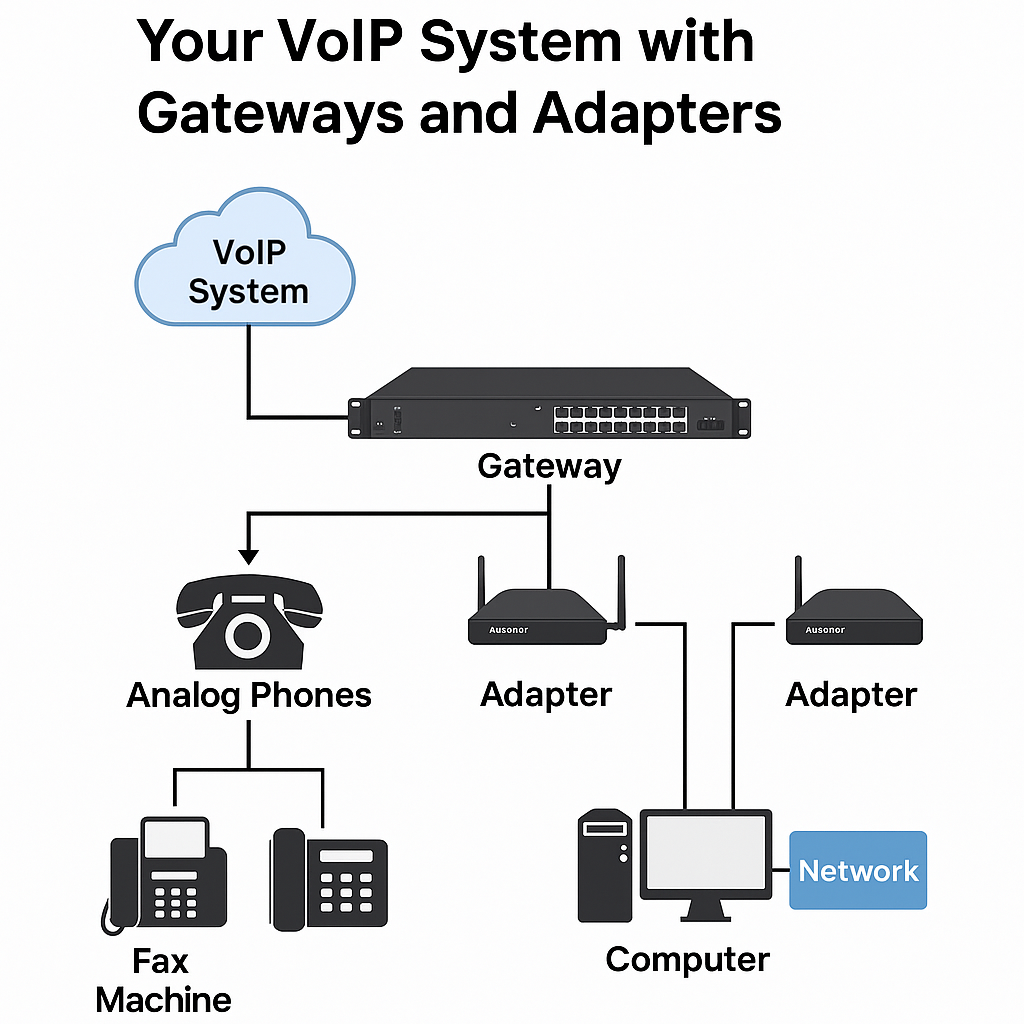
Growing pains don’t only happen to people, they happen to businesses too! It’s fantastic that your business is growing! What is not so fantastic are the growing pains a business owner can experience from quick or excessive growth. One of these pains can be communication needs. If you are already using a VoIP system, no need for a whole overhaul or a new system. If you are working with legacy infrastructures or maybe have analog devices, no worries! Fortunately, there are devices made specifically to help bridge this gap and scale your network. VoIP gateways and analog telephone adapters (ATAs) make it easy to expand your network. Let’s take a look at what these are and how they can help you with your growing pains!
First, let’s make sure we know exactly what VoIP gateways and adapters are. VoIP gateways are devices that convert analog voice signals to digital data for transmission over an IP network. They come in two main types:
FXO Gateways: Connect to the Public Switched Telephone Network (PSTN) to bring traditional phone lines into your VoIP system.
FXS Gateways: Connect analog devices like fax machines, intercoms, or desk phones to your VoIP network.
Analog Telephone Adapters (ATAs) are smaller devices that connect individual analog phones or fax machines to a VoIP system. They’re ideal for smaller deployments or when you only need to integrate a few legacy devices.
There are several scenarios in which you may want to consider using VoIP gateways or adapters.
Continue to use analog phones while migrating to VoIP.
Paging systems utilize analog, and you don’t want to replace them.
Support for analog fax machines.
Multiple locations with legacy infrastructures.
Integration of traditional phone lines (PSTN) for backup or hybrid communications.
Whichever scenario may apply to you and your business, you should start by assessing your current infrastructure. Ask yourself questions like:
Which analog devices or PSTN lines are still in use?
How many endpoints will need connection?
You will then want to select gateways or adapters based on the number of ports required, compatibility with your VoIP platform, power options, and mounting requirements.
See below for various options from popular brands sold at VoIP Supply!
Grandstream 48 FXS Port Gigabit Analog Gateway GXW4248-V2: Enables cost-effective hybrid IP and analog phone systems for any business size. It supports 16 to 48 FXS ports, offers Gigabit connectivity, and ensures compatibility with most SIP platforms.
Patton SmartNode 4141 4 FXO Analog Gateway SN4141/4JO4V/EUI: Bridges old and new technology, making it ideal for integrating legacy phones or fax machines into modern All-IP networks. It offers interfaces, service transparency, and flexibility.
Yeastar NeoGate TA1610 16 FXO Gateway: A 16-FXO gateway fully compliant with SIP and IAX2, offering echo cancellation for up to 128 delays. It supports PnP, DHCP provisioning, TR-069, and SNMP, and includes a 3-year Yeastar warranty.
Sangoma Vega 60GV2 4 Port FXO Media Gateway: Connects legacy phone systems to IP networks, ideal for SIP trunking, IP Centrex, and IP phone survivability. Supports up to 4 analog or BRI lines (12 calls), SIP, T.38 Fax, and offers local survivability during outages.
Cisco ATA 191 Adapter ATA191-K9: Has two standard FXS ports, which can be configured independently as two Session Initiation Protocol (SIP) registrations. Protect and extend existing investments in analog systems.
It may all sound a bit confusing, but if you take away anything from this information, just know that you can save time and money by utilizing gateways and adapters to expand and scale your network without breaking the bank on a whole new system overhaul. Our VoIP Experts are here to help! If you have any questions or comments, you can leave them below, call us at 1-800-398-8647, or chat with one of our VoIP Experts online at www.voipsupply.com.