Four 10 Seat VoIP Phone Systems Under $4,000
You’re a small business. Actually, you’re a very small business – there are only 10 of you.
You don’t have a VoIP engineer on staff and heck, you are lucky if you have an IT person on staff.
However, you know you need to replace your legacy phone system with a VoIP phone system, but you are not sure you can afford to do it – especially in these uncertain economic times. If this is you, then I am pleased to let you know that now, more than ever, it is easy to get a brand new VoIP Phone System at a price you can afford. In fact, you can get a new VoIP Phone System for under $400 USD per person.
That’s right, you can get a brand new VoIP Phone System for your 10 person office for less than $4,000 USD.
Don’t believe me? Let’s take a look at some of the options available.
1. The Grandstream Solution ($1,954)
Recent INC 5000 company Grandstream Networks offers a solid solution for the small business who is looking for a straight forward solution without a lot of bells and whistles. Combo the following to get a VoIP phone solution that will allow you to connect up to four (4) POTS line, while allowing you to make VoIP calls.
- Grandstream UCM6204 IP PBX ($519) VoIP Phone System
- (10) Grandstream GXP2130 ($89ea)
- (1) Cisco SF300 ($544.99)
2. The RenegadePBX mini Bundle Solution ($2,295)
This VoIP phone system offers seamless communication with all hardware and software components allowing for use of all features. The RenegadePBX mini appliance is a small form factor IP PBX that is only 3.8 lbs and 11in x 9in x 3in in size. Within that small desktop IP PBX the appliance is able to handle 100 extensions and 75 concurrent SIP phone calls.
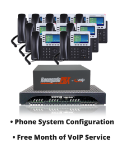 RenegadePBX mini Appliance
- (10) Grandstream GXP2140 VoIP Phones
- Patton SmartNode SN5300 ESBR
- Phone System Configuration
- Free Month of VoIP Service
3. The Sangoma Small Business Phone System ($3,570)
The FreePBX Phone system 60 is an ideal fit for small to medium businesses who are looking to maximize their business phone system. With an easy to use GUI (Graphical User Interface) setup comes with minimal effort. The PBX system has been rigorously tested and is currently the only officially supported PBX appliance for FreePBX. This bundle includes EndPoint Manager, UCP for EPM, FreePBX Phone Apps, SysAdmin Pro, Park Pro, Page Pro, Class of Service, Extension Routing, Conference Pro, Call Recording Reports, Fax Pro, Extension Routing and XMPP management.
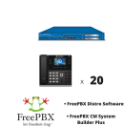 Sangoma FreePBX Phone System 60
- (20)Sangoma s500 VoIP Phones
- FreePBX CM System Builder Plus
4. The Yealink and RenegadePBX Solution ($3,042.14)
This particular small business bundle is built for use with SIP trunks although you do have the option to purchase an analog telephony card to connect to your old telephone lines. If you need assistance with choosing the correct VoIP service provider you can access our CloudSpan MarketPlace with multiple providers to choose from.
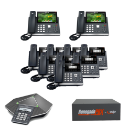 (1) RenegadePBX mini with FreePBX Appliance
- (8) Yealink T42G and (2) T48G VoIP phones
- (1) Yealink CP860 Conference Phone

11 Comments
Nicely done. How about options if you don’t even have the capital to spend up front? Can you do a review of on demand services?
@Rob:
Look for this next week.
What about hosted PBX? My company uses Vocalocity and our cost wasn’t even close to being as high as the cheapest option on your list. All we had to buy was the phones!
@Tom:
You are correct.
Your upfront costs weren’t as high with that Vocalocity solution, but you do have money recurring per seat charges, which after you get up over 10 – 15 seats start to add up. This is something that a premise solution just doesn’t have. Let’s take a closer look.
At an average of $39.99 per month for an unlimited calling seat, a 10 seat hosted system, would run you $399.99 per month or $4,799.88. If you add in 10 IP Phones, at an average cost of $129.99, that adds an additional $1,299.99 to your first year bill.
This gives you a grand first year total cost of $6,099.78 (20% more then my $5K cap). If you wanted to look at it monthly, you would be spending $508.31 per month on this solution.
Now, not every seat needs to be an unlimited seat, but that’s the catch. With Hosted (which works great for many), you have a monthly charge for every seat. Every time you add a new person, to have to add another seat and thus an extra monthly charge. This is not typically true with a premise based solution.
With a premise based solution, you can add users and you don’t have the same per seat charges and since most companies subscribe to a 3 or 2 to 1 rate of users to phone lines, a ten seat company could get away with between 3 and 5 lines. This is because not everyone is on the phone at the same time, therefore not every user needs a dedicated phone line (they can have their own DID or phone number, without the need to have their own line).
So, if you shelled out $1,871 for the Grandstream solution, then picked up five lines of unlimited VoIP calling from Bandwidth.com for $25 per month ($125/month, $1500 annualized), your total first year cost is $3,371 or $280.92 per month. This is about 44% cheaper then going with the Hosted example above (using Vocalocity’s pricing).
Now, for offices with less then ten people, Hosted VoIP is an option (many times a very strong one), but just because there is less to pay up front, doesn’t necessarily mean it is cheaper from a total cost of ownership standpoint.
This is especially true when you get into year two where the monthly cost of the premise solution falls to $125 per month (since hardware was paid for), while the Hosted VoIP solution only falls to $399.99, more then triple the cost of the premise based solution. I’m not saying that you got a raw deal, Tom, I am just saying that when you do an apples to apples comparison, there are advantages on both sides – and the bigger you get the more advantages a premise based solution has.
Look for a post about Hosted VoIP in the near future.
This is an equivalent system I (personally) set up for my small business:
Dell SC440 $349
1 Digium TDM404B $351
10 Polycom 501IP @165=$1650
+ free distribution of Asterisk & setup time =
Grand Total (hardware) $2350.
Our monthly costs for the inbound POTS lines are ~$40/line, so let’s call it $160 for the 4 lines to the Digium card.
1st year costs: $4,270
Nth year costs: $1,920 (fixed)
This installation is impossibly flexible, allowing for upgrades to everything in the system including hardware, phones, and the Asterisk software. Adding a new employee is as difficult as buying a new phone and adding the extension to Asterisk. “Moving” employees from cube to cube is a non-event.
This system can also grow with our company. If we need more lines, we simply add another Digium card.
My only regret is that it took me so long to decide on this as a solution.
Tom, Don’t forget that you have recurring costs.
I am a small business selling VoIP solutions, how’s this Garret?
(1) Talkswitch 844vs $1,795.00
(10) TalkSwitch TS-9133i IP phone (made by Aastra) $1,790.00
for $300.00 you can add the end user software interface.
@Matt:
If you have the technical where with all, then your system is going to be tough to beat.
@ Ruben:
That will work as well. Thinking back, I totally forgot to add in Talkswitch…
As a manager at Vocalocity in the midst of my weekly scan of the VoIP blogosphere, I can’t resist the urge to add my 2 cents.
First, I’ll start by agreeing with Garrett’s basic premise that hosted VoIP becomes less cost effective with larger deployments. However, the argument fails to take into account a few key factors, and I draw the line closer to the 18-20 user range where economies of scale do eventually break down in favor of shared SIP trunks over the per seat model.
a) Installation cost: The guy who sells you the new on-premise phone system isn’t going to install it for free. I’ve worked in the Channel, and a $1000 installation fee is about average. Hosted is plug-n-play, so there is no need for this fee.
b) Maintenance fees: The same guy who sold and installed the phone system is going to want some more fees to maintain it. Fonality, for example, charges in the vicinity of $60/yr/user for support. Hosted providers include support free of charge.
c) Volume discounts: At 10 seats, just about any sales person in the hosted VoIP space will go down to $34.99 per unlimited seat with a DID included if you ask nicely. I’ve seen as low as $29.99, but usually with a contract or proprietary equipment.
d) Equipment quality: The initial example uses the cheapest phone system on the market by a $500 margin, and compares Grandstream GXP2000 ($79) phones with Linksys SPA-941 IP phones ($129.99). It’s been my experience that the firmware and hardware downgrades aren’t worth the savings in the sub-$100 IP phone category.
e) Call Capacity Preferences: While some large businesses are willing to accept the limitations of only 1/3 or ½ of their employees being able to use the phone at the same time, our sales people have found that small businesses owners greatly prefer for everyone to be able to use the phone at the same time (as in the hosted model). Everybody is crucial when you only have 10 people.
f) Cash is king (although Mr. Buffet may disagree): In what you refer to as “uncertain economic times”, startup cost should be given extra consideration. Small business loans just aren’t as easy to come across as they were only a few weeks ago. The money you save by not purchasing on-premise equipment could be used to buy another computer or keep up with payroll.
g) Machines break and become outdated: You don’t want to risk the lifeblood of your business (communication) to disaster when a viable hosted solution is available, and you don’t want to be stuck with yesterday’s technology. The internet cloud is built to be redundant, constantly upgraded, and (eventually) accessed from anywhere.
h) Expansion: Most ten person companies intend to grow, and on premise phone systems don’t expand well or stretch to multiple locations. You’re not going to want to purchase a new (and more expensive) phone system again when you open another office or hire new employees. A hosted solution easily expands and spreads from one location to the next simply by ordering more IP phones. Plus, users have the added benefit of being able to use their phones at home or anywhere else with a reliable broadband connection.
Comparing an expandable hosted VoIP offering that enables everyone to be on the phone at the same time with a budget and breakable on-premise phone system that has half the call capacity isn’t as simple as it first appears. Of course, I’m biased, but there’s my 2…well probably 3-4 cents.
@ Brian:
Great comments and very valuable insights (with the exception of the last paragraph where you took those shots…)!
I will be the first person to admit that there is no such thing as an out-of-the-box offering – every business is different and therefore what works for it varies from business to business.
What I advocated above – and always do – is that people THINK before they make a purchase. Take the time to explore options, break them down, compare them as closely as possible – in a nutshell make an educated decision.
Thanks again for the input – it will surely help those who read this make a more educated decision.
I am looking for a phone system that has voice recognition features to have installed in my accounting office. We will need about 9 phones and it needs to be relatively easy to set up.